

Someone sends you “tf” and you freeze for a second. Is it a joke, is it anger, or is it just a typo? You’re not the only one stuck on it. People look up the TF meaning in chat every single day, because those two letters carry a lot of feeling and almost no explanation. The tricky part is that the same letters can sound playful in one chat and rude in another.
Here’s the short version. TF is slang for “the f***”, a quick way to show shock, anger or disbelief without typing the full phrase. You’ll see it in texts, comments, gaming lobbies and group chats, and it works a lot like its louder cousin, “wtf”.
In this guide, you’ll learn what TF means, where people use it, how to read it in real messages, and when to keep it out of a conversation. You’ll also see the odd meanings it has in money, medicine and even speakers.
What Does TF Mean In Chat?
In chat, TF means “the f***”. It’s a shortcut for the swear phrase people use when they’re shocked, annoyed or confused.
Featured Snippet Answer
TF in chat stands for “the f***”. People type it to show surprise, anger or disbelief, as in “tf is going on?” or “who tf is that?”. It’s casual slang and can sound rude in formal settings.
Simple Meaning (Explained Easily)
So, what is the meaning of tf in plain English? It’s a quick way to say “what on earth” or “seriously?” with extra force, squeezed into two letters.
Picture this. Your friend texts, “My phone died again, right before the call.” You reply, “tf, again?” You’re not asking for a definition. You’re saying you can’t believe it happened one more time.
The tf meaning in gen z chats works the same way, but younger users use it more loosely. They drop it into the middle of a sentence as a stress word, like “stay tf home” or “how tf did that happen”. The German tech site GIGA describes the same habit, where TF fits anywhere the full phrase would fit in a sentence.
Here’s how a reply might look in practice. A friend writes, “Our flight got moved to 5 a.m.” You answer, “tf, why?” That one message carries shock and a question at the same time, which is exactly why people like it. You don’t need to add anything else.
Where Is TF Used? 📱

TF shows up in casual online chat, mostly where people type fast and talk the way they would out loud. If you’ve wondered about the meaning of tf in whatsapp, or what does tf mean in texting on other apps, the answer is the same everywhere: shock, annoyance or emphasis. Only the mood changes.
| Platform | Example message | What it means |
|---|---|---|
| “tf, he cancelled again?” | Annoyed by a last-minute cancellation | |
| Instagram DMs and comments | “tf!” under a wild reel | Pure shock or amazement |
| Snapchat | “who tf is this” | Confused by an unknown sender |
| TikTok comments | “how tf did she do that” | Impressed disbelief |
| Gaming chat and Discord | “tf was that play” | Frustration at a teammate |
| Group texts | “tf is this group name” | Playful confusion |
Tone shifts a little from app to app. Gaming chats are fast and blunt, so a “tf” there rarely means more than “that was a mistake”. Family WhatsApp groups are gentler, and a swear shortcut can stand out. Instagram comments sit in the middle, where the emoji next to it usually settles the mood.
Why Do People Use TF?
People use TF because it packs a strong feeling into two letters. There are four main reasons.
- It’s fast. Two letters beat a full sentence, especially in a live game or a busy group chat. Example: “tf was that?”
- It feels softer than the full phrase. Many people think it sounds less harsh, even though everyone knows what it stands for. Example: “tf is wrong with this app”
- It adds tone. Plain text hides your face, so TF shows how you feel. Example: “Wait, tf, you got the job?!”
- It builds closeness. Friends share slang, and a joking “tf are you wearing” signals you’re relaxed around each other.
Together, these reasons explain why TF has stayed popular. It’s short, expressive and easy to read, as long as the people on the other end share the same slang.
Examples (Real-Life Situations) 💬
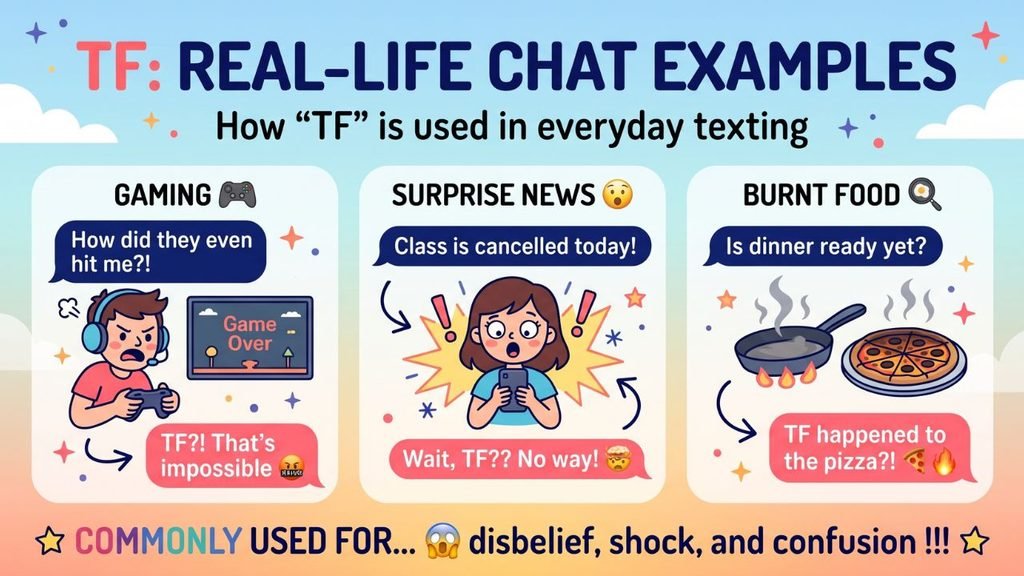
Real messages make the meaning click faster than any definition. Here are five you’re likely to meet.
Example 1: The cancelled plan
- Message: “tf, he cancelled again?”
- Meaning: “Seriously? He did it again?” with clear annoyance.
- Situation: Dinner plans fall apart an hour before everyone leaves home.
Example 2: The shocking news
- Message: “tf!!”
- Meaning: Pure shock, with no anger behind it.
- Situation: A friend shares a screenshot of a surprise engagement announcement.
Example 3: The unknown sender
- Message: “who tf is this”
- Meaning: Confusion with a little edge.
- Situation: A number you don’t know texts “hey, it’s me.”
Example 4: The lost match
- Message: “tf was that play”
- Meaning: Frustration at a teammate’s mistake.
- Situation: The final round of a ranked game slips away.
Example 5: The burnt dinner
- Message: “tf is that, I’m dying”
- Meaning: A joke. The person is laughing, not attacking.
- Situation: Three friends chat in a group, 1-Ayesha 2-Bilal 3-Sana, after Ayesha shares a photo of her burnt biryani.
TF Meaning in Different Contexts 🔍
Outside casual chat, TF can mean something completely different. The topic and the place you see it decide which meaning fits.
TF Meaning in Money
In finance documents, TF can stand for “trust fund”, a pool of money held for a set purpose. If a friend types “tf” while complaining about their bank balance, though, they almost certainly mean the slang version.
TF Meaning in Relationship
Between partners, TF is nearly always the slang version, and tone does the heavy lifting. A shocked “tf?!” at good news feels fun. A sharp “tf is wrong with you” in the middle of an argument can feel like an attack.
TF Meaning in Business
At work, TF usually means “task force”, a small team pulled together for one job. GIGA gives the example of a colleague saying their group just set up a TF, which means a working group rather than a swear. You can read their explanation here.
TF Meaning Medical
In medicine, TF often means “tissue factor”, a protein that starts the blood clotting process, as described in this review on PubMed. Some hospital notes also use TF for tube feeding. Nobody is swearing in a patient file.
TF Meaning in Chart
On a trading chart, TF means “time frame”, the stretch of time each candle covers, such as five minutes or one day. Traders talk about a “higher TF” and a “lower TF” all the time. Gotrade explains the idea in simple terms.
TF Meaning in Speaker
On a speaker’s spec sheet, “TF card” points to the memory card slot. TF stands for TransFlash, which is the original name of the microSD card, as SlashGear explains. iBoysoft lists speakers among the devices that use these cards.
TF vs Similar Terms: How TF Meaning in Chat Compares ⚖️
TF sits in a crowded family of short chat terms, and a few of them look almost identical. This table shows how they differ at a glance.
| Term | Stands for | Usual feel | Example |
|---|---|---|---|
| TF | the f*** | Shock, anger or emphasis | “tf is going on?” |
| WTF | what the f*** | Louder, more direct | “wtf did you do?” |
| TFW | that feeling when | Relatable moment | “tfw the weekend ends” |
| TFTI | thanks for the invite | Often sarcastic | “tfti, I guess” |
| TFTA | depends on the chat | Unclear, so check context | “tfta, appreciate it” |
The odd one out is TFTA. The tfta meaning in chat has no settled slang definition the way TF does. Depending on the conversation, people may read it as “thanks for the add” or a similar thank-you, and AbbreviationFinder lists many unrelated meanings across other fields. If a message with TFTA confuses you, look at the words around it or just ask.
TF vs WTF: What’s the Difference?
WTF is the full question, while TF is the flexible shortcut. WTF usually opens a reaction, as in “wtf happened?”, and it sounds louder and more direct.
TF slips into the middle of a sentence, like “how tf did you find that?”. It can also stand alone as a quick “tf?” or “tf!” when you want a lighter reaction. In practice, many people treat the two as the same thing, and GIGA notes that German chat users often use “tf?” exactly like “wtf”.
Think of it like volume. WTF shouts the whole sentence, while TF is a raised eyebrow dropped into it. Neither is polite in a formal chat, but TF usually draws less attention, which is part of why people reach for it.
When Should You Use It (and When to Avoid It)?
Use TF with close friends in relaxed chats, and skip it anywhere tone matters. A simple test works well: if you wouldn’t swear out loud in that conversation, don’t type TF.
Voice and text work differently, too. A spoken “tf” carries your tone for free, while a typed one gets read in whatever mood the other person happens to be in.
Use it when:
- ✅ You’re chatting with close friends who already use slang
- ✅ The mood is playful, like a meme, a joke or a gaming session
- ✅ You’re reacting to surprising news
- ✅ Other people in the group use it first
Avoid it when:
- ❌ You’re writing to a boss, client or teacher
- ❌ You’re talking to relatives who may not know the slang
- ❌ An argument is heating up and tone could hurt
- ❌ You’re in a school or workplace channel with rules
Common Misunderstandings

Most mix-ups come from reading TF too literally. Four come up again and again.
- “TF always means anger.” It often means shock or humor. A “tf!!” under a puppy video is amazement, not rage.
- “TF is only a swear.” It has other meanings too, such as task force, tissue factor and TF card.
- “TF and TFW are the same.” They aren’t. TFW means “that feeling when” and starts a relatable moment.
- “A friend’s tf is an insult.” Usually it’s aimed at the situation, not at you. “Who tf are you” is the exception, because it points at a person.
Pro Tips for Using TF Correctly (Important Usage Advice) 💡
Read the room first. Check how the other person writes. If they use slang and light swearing, TF fits. If they write in full, careful sentences, match their style.
Let the topic guide you. A chat about charts, hospitals or speakers may use TF in a technical sense. Look at the subject before you assume it’s a swear.
When in doubt, swap it out. “What the heck” or “what on earth” carries the same surprise without the risk. You lose nothing and avoid an awkward moment.
FAQs About TF Meaning in Chat ❓
What does the TF stand for?
TF most often stands for “the f***”, and it can also mean task force, tissue factor, time frame or TF card.
What is TF in Instagram?
On Instagram, TF is the same slang for “the f***”, used in DMs and comments to show shock.
What does TF mean in business?
In business, TF usually means “task force”, a small team formed for one specific job.
Is “tf” considered rude?
It can be, since it’s a swear shortcut that sounds fine with friends but rude to bosses or elders.
Does the meaning change depending on who sends it?
The meaning stays the same, but the tone changes from a joke between friends to irritation from a stranger.
Can I use “tf” in a work chat?
It’s best to avoid it, because a swear shortcut can look unprofessional at work.
What’s the difference between “tf” and “wtf”?
WTF is the full, louder “what the f***”, while TF is the shorter, lighter version that fits mid-sentence.
Conclusion
Now that the TF meaning in chat is clear, the two letters stop being a puzzle. They’re a quick, casual way to show shock, annoyance or emphasis, and the sentence around them tells you which one is meant. Add the other meanings, from task force to TF card, and you can read almost any “tf” you meet.
Use what you’ve learned with care. The TF meaning in chat fits friends, relaxed moods and playful moments, so reach for plainer words when the audience is formal or the topic is tense. A clear message always beats a clever shortcut.

Welcome to Meanzify! I’m James, an AI-powered SEO and content writer with 5 years of experience. Meanzify provides simple and clear meanings of words, slang, abbreviations, acronyms, and phrases in easy-to-understand language.